
How Do You Measure the Density of a Rubber Eraser?
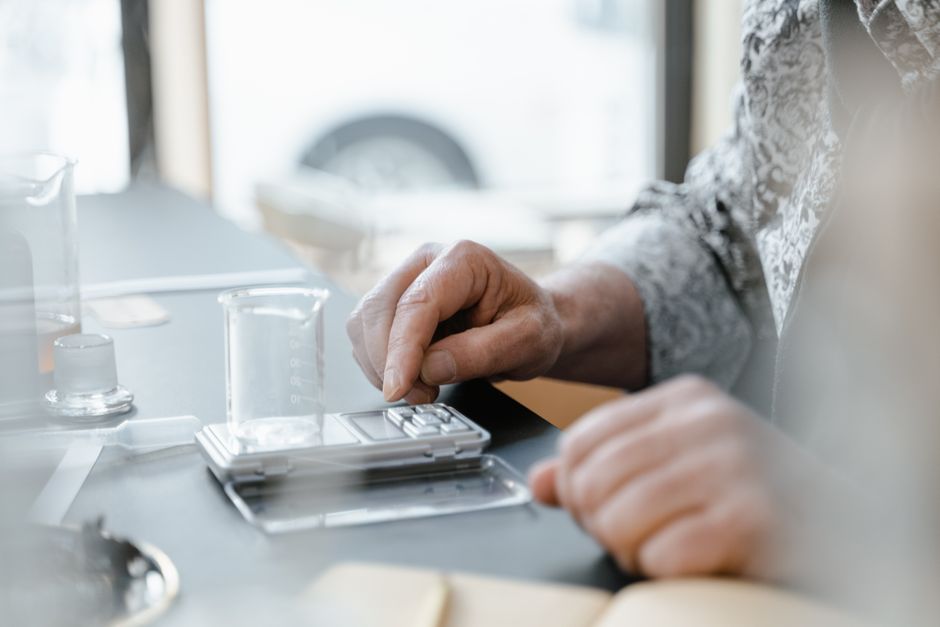
Measure the eraser’s mass in grams, find its volume by subtracting the initial water level from the final level after it is fully submerged, then divide mass by volume. Report the result in g/cm3, since 1 mL equals 1 cm3. Read the bottom of the water’s curve, avoid splashes and bubbles, and repeat the measurement if the result looks inconsistent.
What steps would you take to determine the density of a rubber eraser?
Use a balance for mass and a graduated cylinder for volume. Density is mass divided by volume, written as rho = M/V, according to NASA Goddard Institute for Space Studies. That is the whole job: get two defensible measurements, then do one division.
- Measure mass. Place the dry eraser on the balance and record its mass in grams.
- Set a starting volume. Add enough water to a graduated cylinder that the eraser can be completely submerged. Record the initial volume at the center of the bottom of the concave meniscus.
- Submerge without drama. Gently lower the eraser below the surface. Do not drop it in; splashing loses water and changes the number you need.
- Record the final volume. Wait for the water to come to rest, check for bubbles, then read the meniscus again.
- Calculate volume and density. Subtract initial volume from final volume. Divide the mass by that difference.
Use this data layout. It keeps the calculation visible instead of burying it in a line of notes.
| Measurement | What to record | Calculation |
|---|---|---|
| Mass | Balance reading in g | Mass = ___ g |
| Initial water level | Graduated-cylinder reading in mL | Initial = ___ mL |
| Final water level | Reading after full submersion in mL | Final = ___ mL |
| Eraser volume | Water-level increase | Final − Initial = ___ mL or cm3 |
| Eraser density | Mass divided by volume | g ÷ cm3 = ___ g/cm3 |
For a check on the arithmetic, the Maine Geological Survey gives a specimen example of 42 g displacing 11.6 mL, which produces about 3.62 g/mL. That is not a target result for an eraser; it is a clean model for the calculation. NASA lists rubber at about 1.10 to 1.19 g/cm3 as an approximate comparison range, so a result far outside that range is a reason to inspect the procedure before declaring the eraser unusual.
How do you find the volume of an eraser if it is not a perfect shape?
Find an irregular eraser’s volume by measuring the water it displaces when it is fully submerged. You do not need to force a lumpy or worn eraser into a length-times-width-times-height formula; the water-level change does the volume measurement directly.
The Florida State University Department of Chemistry and Biochemistry explains that the displaced-water volume of a fully submerged object equals the object’s volume. If the cylinder rises from one marked level to another, subtract the first reading from the second. NOAA Ocean Explorer adds the useful unit shortcut: 1 mL equals 1 cm3, so the result can go straight into a density calculation with grams.
Run the two-reading rule: record the water level before the eraser enters, then record it after the eraser is fully under. Do not use the final reading alone. The difference is the measurement that carries the decision.
Read the meniscus consistently. Water forms a concave curve, and FSU directs students to read the center of the curve’s bottom. For a cylinder marked in 1 mL increments, estimate one additional digit and record to the nearest 0.1 mL. That small discipline reduces cognitive load when you compare repeated trials, much like checking every input before you verify a Toyota deal by comparing the out-the-door total.
Why does the water level rise when an object is put in a graduated cylinder?
The water level rises because a submerged object takes up space and pushes aside its own volume of water. That is why displacement works: the increase in the cylinder is the object volume, provided the object is completely submerged and no water is lost.
NOAA Ocean Explorer connects this observation to Archimedes’ principle: an object in a fluid experiences an upward buoyant force equal to the weight of the displaced fluid. The practical version is simpler. An eraser that sinks displaces its full volume on its own; an object that floats must be held under water before you take the final reading.
Use the quiet-cylinder check before writing the final number: water settled, object fully submerged, no bubbles clinging to it, and no splash marks suggesting lost water. Truman State University specifically directs students to gently tap the cylinder to dislodge attached air bubbles. A bubble adds apparent volume. Your division then produces a density that looks precise but is wrong.
If the object dissolves in water or absorbs it, this water-displacement method is a poor fit because its mass or shape can change during the test. The provided sources do not give a substitute method for those materials. State that limitation in a lab report rather than presenting an unstable result as a clean measurement.
Frequently Asked Questions
What is the density formula and which units should I use?
Use density = mass divided by volume. For a solid measured with grams and water displacement, report the result in g/cm3; a milliliter of displaced water equals a cubic centimeter.
What should I do if the object floats in the water?
Push the object fully below the water surface with stiff wire or a straightened paper clip, then record the final water level. Include the effect of the tool in your setup so the object’s displaced volume, not the tool’s volume, is what you calculate.
What mistakes make a water-displacement density result inaccurate?
Splashing or spilling water, trapped air bubbles, reading the wrong part of the meniscus, and taking a reading before the water settles can all distort the volume difference. Use enough water to submerge the object, lower it carefully, tap away bubbles, and estimate an extra digit beyond the cylinder markings when instructed.
Homework: Run the measurement twice using the same eraser. Put both mass, initial volume, final volume, calculated volume, and density in one table. If the density results disagree, identify which reading changed and redo that step before averaging anything.
Sources
Keep reading

How Does Multilevel and Multidimensional Association-Rule Mining Work?
A clear guide to multilevel, multidimensional, quantitative, rare, and negative association-rule mining for data-mining students.
How Do I Identify and Correct Single-Cell Depressions in a DEM?
A practical GIS workflow for finding artificial DEM pits, choosing sink treatments, and validating watershed results.

Can Anything During Pregnancy Cause Autism?
A plain-language guide to pregnancy factors linked with autism, what association means, and how to discuss evidence without blame.